
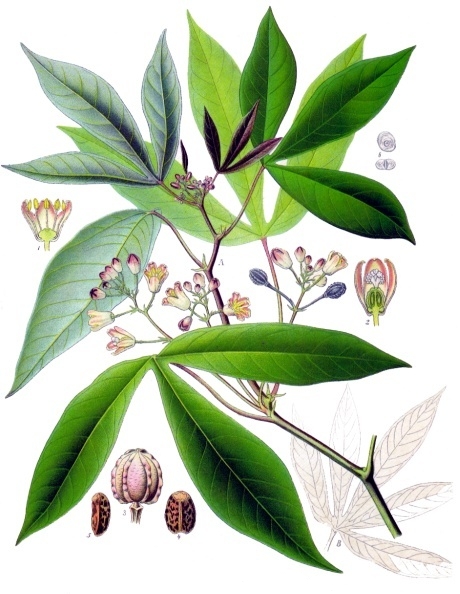
Manihot esculenta
Mes Euphorbiaceae Malpighiales

Manihot esculenta

36 2n Chromosomes
Euphorbiaceae Family
Taxonomic Classification
Kingdom Plantae Phylum Magnoliophyta Class Magnoliopsida Order Malpighiales Family Euphorbiaceae
Genome & Ploidy
2n
36 chromosomes
Polyploidy History (PhyloWGD)
Browse all →
Loading…
Species Notes
Description
Manihot esculenta, commonly called cassava, manioc, or yuca, is a woody shrub of the spurge family, Euphorbiaceae, native to South America, from Brazil, Paraguay and parts of the Andes. Although a perennial plant, cassava is extensively cultivated in tropical and subtropical regions as an annual crop for its edible starchy tuberous root. Cassava is predominantly consumed in boiled form, but substantial quantities are processed to extract cassava starch, called tapioca, which is used for food, animal feed, and industrial purposes. The Brazilian farofa, and the related garri of West Africa, is an edible coarse flour obtained by grating cassava roots, pressing moisture off the obtained grated pulp, and finally drying and roasting it.
Data source
build_pgdd_species_jsons.py
Wikipedia
View article
Downloads
Protein sequences
FASTA (.pep) — amino acid sequences for all annotated genes
Gene coordinates
BED format — chromosomal positions for MCScanX input
Coding sequences
FASTA (.cds) — nucleotide CDS for Ka/Ks analysis
Gene type annotations
TSV — gene duplication classifications
CDS not in local archive — search on NCBI
Grayed items are not yet available in local archive.
Analysis Tools
Synteny & Collinearity
Evolutionary Analysis
Sequence Search
Related Literature (genome, WGD & evolution)
Searching PubMed…